Han Kang: The Nobel Prize-Winning Korean Author Who Changed World Literature
For many years, Korean culture became globally famous through K-pop, films, and television dramas. Yet long before Korean entertainment captured worldwide attention, Korean literature had been quietly producing remarkable works that explored humanity, grief, memory, identity, and hope.
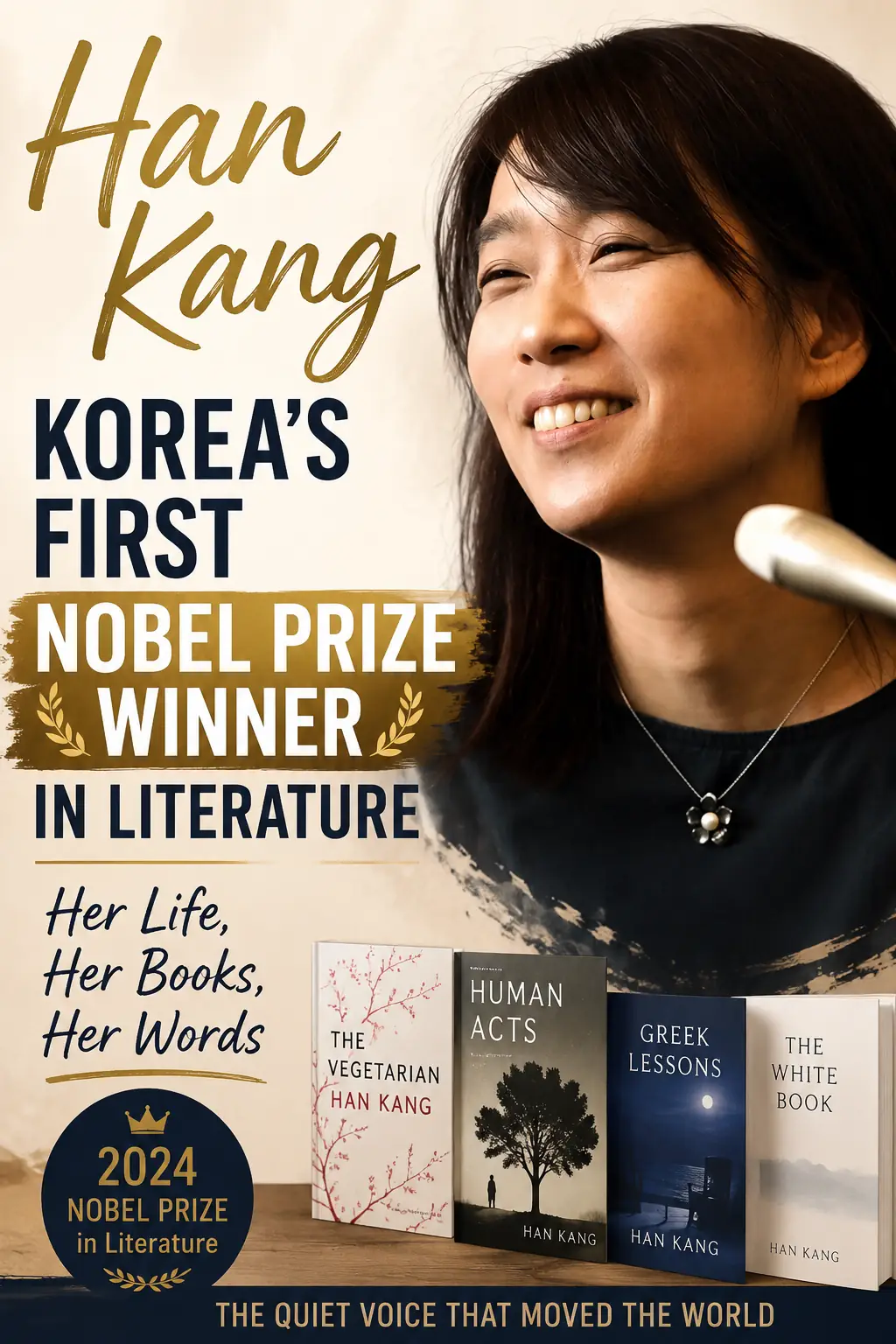
One author stands above many others in bringing Korean literature to international readers: Han Kang. In 2024, she became the first Korean writer to receive the Nobel Prize in Literature, introducing millions of readers to stories that are deeply rooted in Korean history while speaking to universal human experiences.
If you’ve never read Han Kang before, this guide introduces her life, explains why the Nobel Committee honored her, explores her most famous novel The Vegetarian, and highlights insights from her Korean interviews that reveal the philosophy behind her writing.
Key Takeaways
- Han Kang became the first Korean recipient of the Nobel Prize in Literature in 2024.
- Her novels explore trauma, memory, compassion, and the meaning of being human.
- The Vegetarian introduced millions of international readers to Korean literature.
- Many of her stories are inspired by real Korean history and collective memory.
- Han Kang believes literature should ask difficult questions rather than provide simple answers.
Suggested Image after Introduction: Korean bookstore displaying translated editions of Han Kang’s novels.
Who Is Han Kang?
Han Kang (한강) was born in Gwangju, South Korea, in 1970. Her father, Han Seung-won, is also a respected novelist, which meant books surrounded her from childhood. Although literature was always present in her life, Han Kang gradually developed a distinctive voice entirely her own.
When she was young, her family moved to Seoul. During her school years she became fascinated by poetry, philosophy, and classical literature. Before becoming internationally famous as a novelist, she first published poems and later short stories.
Unlike writers who focus primarily on plot-driven stories, Han Kang often writes emotionally layered novels that invite readers to reflect rather than simply consume a story. Her books move slowly, asking readers to sit with uncomfortable emotions and difficult questions.
Many critics describe her writing as lyrical, poetic, and haunting. Her prose frequently explores:
- human suffering
- physical and emotional hardship
- memory
- nature
- silence
- compassion
- the boundaries between life and death
Although these subjects sound heavy, Han Kang’s novels are not simply pessimistic. Instead, they explore how people continue living despite pain and whether kindness can survive in a harsh world.
This emotional depth has made her one of Korea’s most respected contemporary writers while also attracting readers around the globe.
| Fact | Details |
|---|---|
| Born | 1970, Gwangju, South Korea |
| Occupation | Novelist, Essayist, Poet |
| International Breakthrough | The Vegetarian |
| Nobel Prize | Literature (2024) |
| Writing Themes | Memory, trauma, humanity, compassion |
Why Han Kang Won the Nobel Prize in Literature
In October 2024, the Swedish Academy awarded Han Kang the Nobel Prize in Literature, making history as the first Korean author ever to receive the award.
The Nobel Committee praised her:
“for her intense poetic prose that confronts historical traumas and exposes the fragility of human life.”
This citation perfectly summarizes what makes Han Kang unique. Rather than writing stories with clear heroes and villains, she explores ordinary people struggling to survive extraordinary emotional experiences.
Several of her novels are inspired by historical events in Korea, including the 1980 Gwangju Uprising, one of the country’s most painful chapters. Instead of describing history through political speeches or military strategy, Han Kang focuses on individual lives—the families, children, friends, and ordinary citizens affected by hardship.
Her novels ask profound questions:
- What does suffering do to the human soul?
- Can compassion exist after unimaginable suffering?
- How should societies remember painful history?
- What responsibilities do future generations have toward memory?
These are not questions limited to Korea. They resonate across cultures, which is one reason readers worldwide connect so deeply with her work.
The Nobel Prize also recognized the growing influence of Korean literature internationally. Translation has played a major role, allowing readers in dozens of languages to experience voices that were previously known mainly within Korea.
Han Kang herself has consistently emphasized that literature crosses borders. While her stories emerge from Korean experiences, they ultimately examine universal emotions shared by all humanity.
The Vegetarian: The Novel That Introduced Han Kang to the World
Although Han Kang had already built a respected literary career in South Korea, it was The Vegetarian that introduced her to millions of international readers. Originally published in Korean in 2007 and later translated into English by Deborah Smith, the novel won the prestigious International Booker Prize in 2016, making Han Kang a globally recognized literary voice.
At first glance, the story appears surprisingly simple. Yeong-hye, an ordinary Korean woman, suddenly decides to stop eating meat after experiencing disturbing dreams. What begins as a personal dietary choice quickly grows into something much deeper. Her decision challenges the expectations of her family, her marriage, and Korean society itself.
As those around her struggle to understand her actions, the novel gradually transforms into an exploration of identity, autonomy, and what it truly means to be human.
Summary of The Vegetarian (Spoiler-Light)
The novel is divided into three interconnected parts, each told from the perspective of someone close to Yeong-hye rather than from her own point of view.
- The Husband: He sees Yeong-hye as an ordinary wife until her refusal to eat meat disrupts the routine life he values.
- The Brother-in-law: An artist who becomes fascinated by Yeong-hye in increasingly disturbing ways.
- The Sister: In-hye struggles to understand her sister while confronting her own emotional wounds and responsibilities.
Rather than explaining everything directly, Han Kang allows readers to piece together Yeong-hye’s emotional journey through the observations of others. This unusual structure creates a sense of mystery while inviting readers to question whose version of reality they can trust.
The novel is not simply about vegetarianism. Instead, it examines themes such as:
- personal freedom
- control over one’s own body
- family expectations
- hidden suffering within ordinary life
- mental health
- the desire to escape human cruelty
Because these themes are universal, readers from many different cultures have found something meaningful in Yeong-hye’s story.
| Book | The Vegetarian |
|---|---|
| Original Publication | 2007 |
| Genre | Literary Fiction |
| Main Themes | Identity, freedom, family, humanity |
| International Recognition | International Booker Prize (2016) |
Other Essential Books by Han Kang
Although The Vegetarian remains her most internationally famous novel, many critics believe Han Kang’s later works reveal an even greater depth of literary achievement.
Human Acts
Inspired by the 1980 Gwangju Uprising, Human Acts follows the lives of people forever changed by political events. Rather than focusing on politics itself, Han Kang tells deeply personal stories about grief, memory, and the responsibility of remembering those who suffered.
Many Korean readers consider this one of the most important modern Korean novels because it confronts a painful period that shaped the country’s democracy.
The White Book
This quiet, reflective work is composed of short meditations centered around white objects—snow, paper, cloth, rice, and more. Inspired by the death of Han Kang’s older sister shortly after birth, the book explores absence, mourning, and fragile beauty.
Greek Lessons
This novel tells the story of a woman who gradually loses her ability to speak and a language teacher who is slowly losing his eyesight. Through their relationship, Han Kang examines communication beyond words and the quiet resilience of human connection.
We Do Not Part
One of Han Kang’s most recent novels revisits another painful chapter of Korean history while exploring friendship, memory, and the enduring impact of trauma across generations. It demonstrates her continued commitment to preserving stories that might otherwise fade from public memory.
What Han Kang Has Shared in Korean Interviews
One of the reasons many readers admire Han Kang is that she speaks with remarkable humility. In Korean interviews, she rarely describes herself as someone with answers. Instead, she often says that writing begins with questions she cannot resolve.
She has explained that every novel starts with a question that stays with her for years before she begins writing. Rather than creating stories to deliver clear messages, she writes to better understand the complexity of being human.
“I don’t write because I already know the answer. I write because I want to keep asking the question.”
Another recurring idea in her interviews is compassion. Han Kang has said that even when writing about cruelty, she hopes readers will ultimately discover traces of kindness and humanity hidden beneath suffering.
Following her Nobel Prize announcement, she expressed gratitude while also emphasizing that literature is never the achievement of one individual alone. She acknowledged the many writers, translators, editors, publishers, and readers who make literature possible across cultures.
She has also spoken about silence—both in life and in writing. Rather than filling every page with explanations, she believes silence allows readers to enter the story themselves and experience emotions that cannot always be expressed through language.
As a Korean, Why This Nobel Prize Felt So Special
As a Korean myself, seeing Han Kang receive the Nobel Prize in Literature was an incredibly emotional moment. Growing up, I often felt that Korean literature remained largely unknown outside Korea, even though it contained extraordinary stories and talented writers.
Watching Han Kang become the first Korean author ever to win the Nobel Prize in Literature felt like watching an entire nation’s literary heritage finally receive the global recognition it deserved. It wasn’t simply an award for one novelist—it was a moment that shone a spotlight on Korean language, history, culture, and storytelling.
I felt an overwhelming sense of pride. As the announcement spread around the world, I couldn’t help but smile knowing that readers everywhere would begin discovering Korean books that many of us have cherished for years.
Her achievement also reminded me that great literature transcends language and borders. Stories born from Korea’s unique history can still touch readers in Europe, the Americas, Africa, Oceania, or anywhere else because they speak to universal emotions—love, grief, fear, compassion, and hope.
For me, Han Kang’s Nobel Prize wasn’t just Korea making history. It was a powerful reminder that quiet voices can eventually reach the entire world.
Image Recommendation: A symbolic illustration of Korea connected to the world through books, with warm light radiating outward.
Frequently Asked Questions
1. Why did Han Kang win the Nobel Prize?
The Swedish Academy recognized her “intense poetic prose that confronts historical traumas and exposes the fragility of human life.” Her novels combine literary beauty with profound explorations of humanity.
2. Which Han Kang book should I read first?
Most readers begin with The Vegetarian because it introduced her to international audiences. If you’re interested in Korean history, Human Acts is another excellent starting point.
3. Is The Vegetarian really about vegetarianism?
No. While the story begins with one woman’s decision to stop eating meat, the novel is primarily about identity, freedom, and resistance to social expectations.
4. Are Han Kang’s books difficult to read?
Her writing is literary and reflective rather than fast-paced, but many readers find it deeply rewarding. Taking time to reflect between chapters often enhances the experience.
5. Why is Han Kang important for Korean literature?
She introduced Korean literature to millions of readers worldwide and became the first Korean author to receive the Nobel Prize in Literature, marking a historic milestone for Korea’s literary tradition.
Final Thoughts
Han Kang’s Nobel Prize in Literature was more than a personal achievement—it was a landmark moment for Korean literature and for readers around the world who believe that powerful stories can cross every cultural and linguistic boundary.
Through novels like The Vegetarian, Human Acts, The White Book, and Greek Lessons, Han Kang invites us to slow down and consider difficult questions about memory, compassion, identity, and what it truly means to remain human.
As someone who grew up in Korea, seeing Han Kang become the first Korean writer to receive the Nobel Prize in Literature was genuinely moving. It felt as though the quiet voices of Korean literature—voices that had long deserved wider recognition—were finally being heard around the world.
For readers who have only discovered Korean culture through K-pop or Korean dramas, Han Kang’s work offers another doorway into Korea. Her novels reveal not only Korea’s history and culture but also universal emotions that connect readers regardless of where they come from.
If you’ve never read one of her books, The Vegetarian is an excellent place to begin. Once you’ve experienced her unique writing style, you’ll likely find yourself exploring the rest of her remarkable body of work.
Sometimes the most unforgettable books aren’t the loudest bestsellers—they are the quiet ones that stay with you long after you’ve turned the final page. Han Kang’s novels belong in that rare category.
Further Reading
- 5 Hidden Korean Books Every Reader Should Discover
- Why Asian Books Are Hidden Gems Worth Reading
- The History Behind Han Kang’s Human Acts
- 10 Award-Winning Korean Authors You Should Know
- The Rise of Korean Literature Around the World