Why Books from Asia Are Hidden Gems: Stories That Connect Cultures and Ancient Wisdom
Walk into almost any English-language bookstore, and you’ll quickly notice a pattern. The shelves are filled with books from North America and Europe, while only a small corner is dedicated to literature from Asia. Even then, many of those titles are already internationally famous bestsellers.
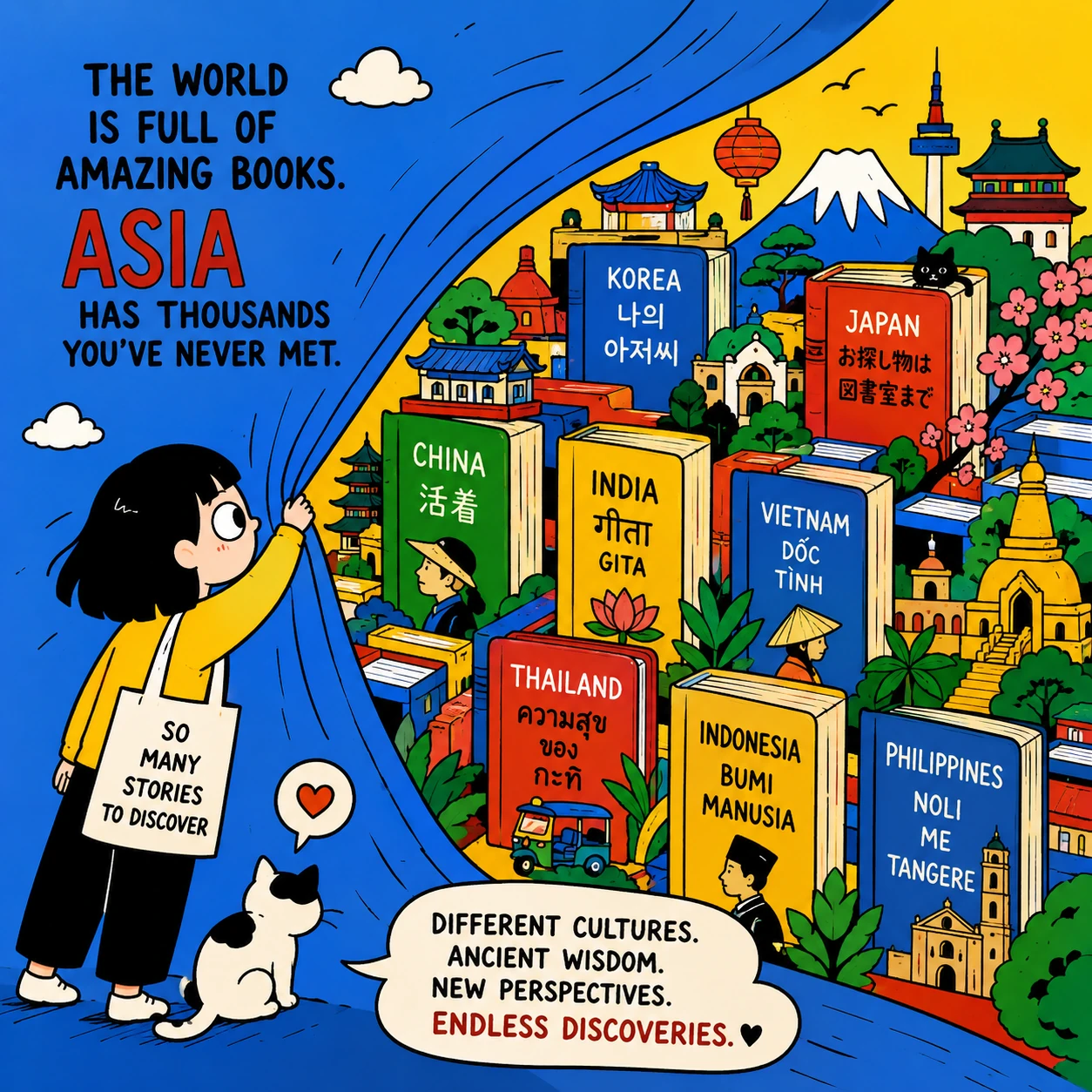
Yet Asia is home to more than half of the world’s population, thousands of years of recorded history, countless philosophies, and one of the richest storytelling traditions on Earth. From Japanese essays about simple living to Korean memoirs, Chinese historical classics, Indian philosophy, Southeast Asian folklore, and Tibetan spiritual teachings, there is an extraordinary collection of books that many English readers never get the chance to discover.
After living overseas for many years, I slowly realized something surprising. Friends around me often assumed that the few famous Asian books translated into English represented Asian literature as a whole. But growing up in Korea, I knew there were thousands of meaningful books that had never crossed language barriers. Some became bestsellers in their own countries, changed public conversations, or comforted generations of readers, yet remained almost invisible internationally.
That realization inspired the vision behind this website. Rather than focusing only on globally famous books, I wanted to build a place where readers could discover remarkable books from across Asia—both well-known classics and lesser-known treasures that deserve far more attention.
In this article, we’ll explore why Asian books are often hidden gems, how they preserve centuries of culture and wisdom, why translation remains a challenge, and why reading books from Asia can completely change how we see the world.
Key Takeaways
- Many outstanding Asian books have never been translated into English.
- Asian literature preserves centuries of history, philosophy, and cultural traditions.
- Reading books from different cultures builds empathy and broadens perspectives.
- Translation barriers—not quality—often prevent great books from reaching global audiences.
- Discovering lesser-known Asian books offers readers fresh ideas unavailable in mainstream publishing.
Asia Holds One of the World’s Greatest Collections of Untold Stories
Asia is incredibly diverse. More than 40 countries, thousands of languages and dialects, and countless ethnic communities have created literary traditions that stretch back thousands of years. Each region has developed its own unique storytelling style shaped by history, religion, geography, and everyday life.
When people think of Asian literature, a handful of internationally recognised authors often come to mind. While these writers deserve their success, they represent only a tiny fraction of what exists. Behind every internationally translated bestseller are thousands of local books that remain unknown outside their home countries.
Consider just a few examples:
- Japanese books exploring quiet living, craftsmanship, and everyday philosophy.
- Korean memoirs, essays, and healing books that rarely receive English editions.
- Chinese historical novels spanning generations of political and family change.
- Indian spiritual writings and philosophical works extending far beyond yoga.
- Thai, Vietnamese, Indonesian, and Filipino literature reflecting unique cultural experiences.
Many of these books become cultural milestones within their own countries. Some influence education, social movements, or popular thinking for decades. Yet outside their borders, they remain virtually unknown simply because no publisher has invested in translation.
This creates an enormous opportunity for curious readers. Instead of reading only what the global publishing industry promotes, readers can discover entirely new voices, ideas, and perspectives that feel refreshingly different.
Translation Is the Biggest Barrier—Not the Quality of the Books
One of the biggest misconceptions is that if a book is excellent, it will naturally be translated into English. Unfortunately, publishing doesn’t work that way.
Translation is expensive. Publishers must purchase international rights, hire experienced translators, edit the manuscript for a different audience, market the book, and hope enough readers buy it to recover the investment. Because of these financial risks, publishers often choose books that already have commercial success or international recognition.
That means thousands of remarkable books never leave their original language—not because they lack quality, but because the economics don’t work.
Living overseas helped me notice this gap more clearly. Friends frequently asked me for recommendations about Korean books beyond the handful available in bookstores. I often found myself thinking about books I had enjoyed years earlier that simply didn’t exist in English.
The same situation exists across Asia. Readers in Japan know wonderful Japanese authors that Western readers have never heard of. Readers in Taiwan know bestselling Taiwanese writers unavailable in English. Indonesian readers have beloved classics that remain unknown internationally.
The language barrier quietly hides entire libraries from the rest of the world.
Fortunately, this is slowly changing. Independent publishers, university presses, and dedicated translators have begun introducing more Asian voices to global readers. While progress is encouraging, there is still an enormous collection waiting to be discovered.
Ancient Wisdom That Still Speaks to Modern Life
One of the reasons I find Asian books so fascinating is that many of them are not simply written to entertain. They often invite readers to pause, reflect, and look inward. Whether the subject is family, work, relationships, spirituality, or personal growth, there is usually an underlying question: How should we live a meaningful life?
This way of thinking has been shaped by centuries of philosophy and cultural traditions. Confucianism has influenced ideas about family, education, and social responsibility throughout East Asia. Buddhism has inspired books about compassion, mindfulness, and letting go of attachment. Taoist teachings encourage living in harmony with nature rather than constantly struggling against it. Hindu philosophy explores purpose, duty, and self-discovery through countless texts and stories.
These ideas appear not only in ancient classics but also in modern novels, essays, memoirs, and even children’s books. A contemporary Korean essay about burnout may echo values that have been passed down for generations. A Japanese novel about everyday life may quietly reflect Zen principles without ever mentioning religion. A Chinese family saga often explores respect for ancestors, changing social expectations, and the balance between individual dreams and family responsibilities.
What makes these books particularly valuable today is that many of the challenges they discuss are universal. People everywhere experience stress, loneliness, uncertainty, grief, and hope. Although the cultural settings may be unfamiliar, the emotions are deeply relatable.
Modern readers are also rediscovering that slower, more thoughtful books offer something different from today’s fast-moving digital world. Instead of providing quick answers or productivity hacks, many Asian authors encourage patience, observation, humility, and continuous learning.
This doesn’t mean every Asian book shares the same philosophy. Asia is incredibly diverse, and each country has developed its own literary voice. Japanese minimalism feels very different from Indian epics. Korean social commentary differs from Tibetan spiritual writings. Vietnamese historical novels offer perspectives that are unlike Chinese martial arts fiction.
That diversity is precisely what makes exploring Asian literature so rewarding. Rather than presenting a single worldview, it introduces readers to many different ways of understanding life.
| Region | Common Literary Themes |
|---|---|
| Japan | Mindfulness, simplicity, nature, everyday beauty |
| Korea | Family, resilience, identity, healing, social change |
| China | History, philosophy, family legacy, political change |
| India | Spirituality, ethics, mythology, self-discovery |
| Southeast Asia | Community, folklore, colonial history, cultural identity |
Reading Across Cultures Builds Understanding
Books do more than tell stories—they introduce us to people we might never meet and places we may never visit. Reading literature from another culture helps us see the world through someone else’s experiences, making unfamiliar traditions feel personal and understandable.
When I first moved overseas, I realised that many people genuinely wanted to learn about Asian cultures but had limited access to authentic voices. Their understanding often came from popular films, television, news headlines, or the few internationally famous books available in English. While these sources have value, they can only show a small part of a much larger picture.
That experience made me appreciate how important books are as cultural bridges. A novel can reveal what everyday family life feels like. A memoir can explain historical events through personal experiences. An essay collection can introduce values and customs that rarely appear in travel guides or documentaries.
The opposite is also true. Reading books from different cultures reminds us that people share far more similarities than differences. Parents worry about their children. Young adults search for purpose. Elderly people reflect on their lives. Communities celebrate traditions while adapting to change. These experiences appear repeatedly across literature from every country.
As readers become familiar with stories from different parts of Asia, stereotypes begin to fade. Instead of seeing a country through a single narrative, readers begin to recognise its diversity of opinions, generations, personalities, and lifestyles.
This broader perspective is increasingly valuable in today’s connected world. International travel, multicultural workplaces, and global business mean we interact with people from many different backgrounds. Reading their stories can help us communicate with greater empathy and respect.
Personally, one of the most rewarding moments is recommending a book from Korea or another Asian country and hearing someone say, “I never knew this existed.” Those conversations remind me that there are still countless wonderful books waiting to find new readers across the world.
How to Start Discovering More Books from Asia
Exploring Asian literature can feel overwhelming at first simply because there is so much to choose from. The good news is that you don’t need to read everything. Starting with just one country, one genre, or one topic can open the door to an entirely new reading journey.
Here are a few practical ways to begin:
-
Start with translated contemporary books.
Modern translations are generally easier to read while still offering authentic cultural perspectives. -
Explore beyond bestselling titles.
International bestsellers are excellent introductions, but don’t stop there. Smaller publishers often translate remarkable books that receive little publicity. -
Read essays and memoirs.
These genres often provide the clearest window into everyday life, traditions, and personal experiences. -
Mix classics with modern works.
Reading both helps you understand how societies have changed while preserving cultural values. -
Follow publishers specialising in Asian literature.
Many independent publishers dedicate themselves to bringing overlooked voices into English. -
Keep a reading journal.
You’ll notice recurring themes, philosophies, and cultural references that become more meaningful over time.
The goal isn’t simply to read more books. It’s to discover stories that expand your understanding of people and places you may never have encountered otherwise.
That is also the purpose of this website. Rather than creating endless lists of global bestsellers, I hope to introduce readers to books from across Asia that deserve more attention. Some are internationally recognised, while others remain hidden because they have never been translated or widely promoted. Every recommendation is an invitation to explore a different culture through its own stories and ideas.
Frequently Asked Questions
Why are so many Asian books unavailable in English?
Translation requires significant investment in publishing rights, professional translators, editing, and marketing. Many excellent books remain untranslated because publishers cannot guarantee enough international sales to recover those costs.
Which Asian country has the most books translated into English?
Japan currently has one of the strongest international publishing presences in Asia, followed by countries such as South Korea, China, and India. However, many outstanding books from every Asian country remain unavailable in English.
Are Asian books only about history or spirituality?
Not at all. Asian literature includes every imaginable genre, including science fiction, romance, crime, business, children’s books, psychology, memoirs, self-improvement, fantasy, and contemporary fiction.
Can translated books still reflect the original culture?
A good translation preserves the author’s voice and cultural context while making the book accessible to readers in another language. Although some nuances may be difficult to translate perfectly, skilled translators work carefully to retain the original meaning.
How can I discover lesser-known Asian books?
Independent publishers, university presses, cultural organisations, libraries, and websites dedicated to Asian literature are excellent places to begin. Recommendations from readers who know the original language can also uncover remarkable hidden gems.
Why does this website focus on books from Asia?
The idea grew from my own experience of living overseas and realising how many wonderful Asian books were unknown simply because they had never been translated into English. I hope this website helps readers discover stories, wisdom, and perspectives that deserve a much wider audience.
Conclusion
Books have always been one of the most powerful ways to understand people beyond our own experiences. While many readers are familiar with a handful of internationally celebrated Asian authors, they represent only a small fraction of the stories that exist across the continent.
From ancient philosophical writings and historical epics to modern memoirs, essays, and novels, Asia offers an extraordinary literary heritage that deserves greater recognition. Unfortunately, language barriers and the economics of publishing mean that countless remarkable books remain unavailable to English-speaking readers.
Living overseas made me appreciate this gap even more. I often found myself thinking about books that shaped my understanding of life while growing up—books that my friends abroad had never heard of because they had never been translated. That realization became the inspiration for building this website.
My hope is that Yes This Book becomes more than a collection of book recommendations. I hope it becomes a bridge between cultures, introducing readers to voices, ideas, and stories that might otherwise remain hidden. Some books featured here will be internationally recognised classics, while others will be forgotten masterpieces waiting for new readers.
If one recommendation encourages someone to discover a new culture, reflect on life from a different perspective, or simply find a meaningful book they would never have encountered otherwise, then this project has already achieved its purpose.
The world doesn’t need more identical bestseller lists. It needs more curiosity, more cultural exchange, and more opportunities to hear stories from every corner of the world. Asia has countless stories waiting to be discovered—and perhaps your next favourite book is one of them.