5 Hidden Korean Books That Deserve an English Translation
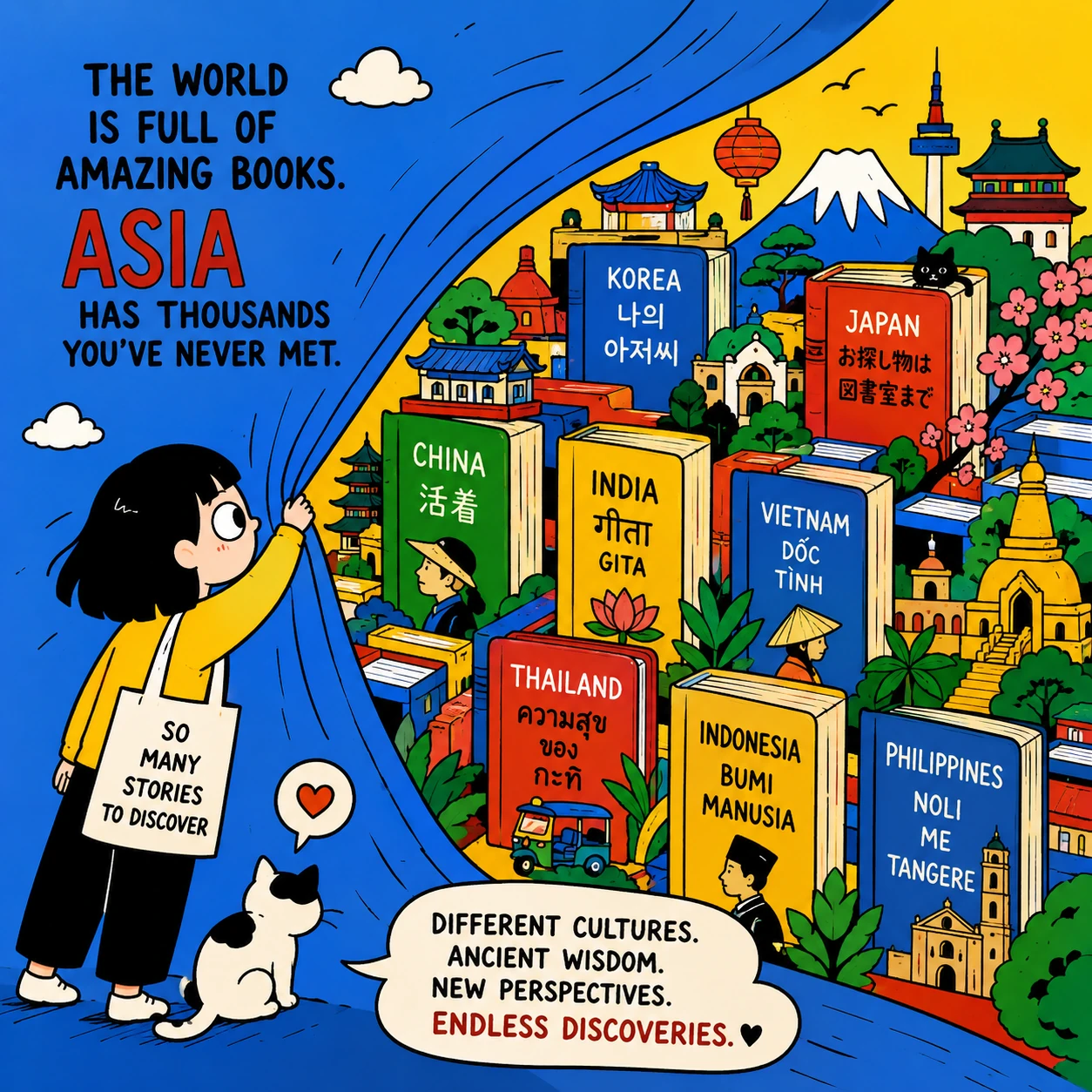
For many English-speaking readers, Korean literature begins and ends with a handful of internationally acclaimed authors. While those books deserve their recognition, they represent only a tiny fraction of Korea’s rich literary landscape. Thousands of beloved novels, memoirs, essays, and philosophical works remain unavailable to readers simply because they have never been translated into English.
As a Korean who has spent the last 30 years living in the United States and New Zealand, this has always surprised me. Growing up, I watched certain books shape conversations, comfort difficult times, and influence generations of readers. Yet when I searched for them overseas, many simply didn’t exist in English bookstores or libraries.
During my four-hour daily train commute, I rediscovered many of these books and realized how much English-speaking readers are missing. Some tell deeply human stories that cross cultural boundaries. Others quietly share timeless wisdom that feels just as relevant today as when they were first written.
This list isn’t about the “best” Korean books ever written. Instead, it’s a collection of remarkable works that I believe deserve a much wider audience.
Hidden Korean Books: Key Takeaways
- Korea has countless outstanding books that have never been translated into English.
- Many hidden Korean classics explore universal themes of family, identity, resilience, and hope.
- Translation helps preserve culture while making great stories accessible worldwide.
- Some of Korea’s most influential books remain almost unknown outside Korea.
- Readers interested in Asian literature have far more to discover than current bestseller lists.
Why So Many Great Korean Books Never Reach English Readers
The popularity of Korean dramas, films, and music has introduced millions of people to Korean culture. However, Korean publishing has not experienced the same global exposure.
Translating a book is expensive and time-consuming. Publishers often focus on titles that already have commercial potential overseas, meaning many wonderful books never receive an English edition regardless of their popularity at home.
As a result, English readers often encounter only a small selection of Korean literature. Behind those few translated titles lies an enormous collection of stories that explore modern Korean society, ancient traditions, philosophy, humour, grief, family relationships, and everyday life.
Many of these books are bestsellers in Korea, taught in schools, or passed between generations of readers. Yet outside Korea, few people have ever heard of them.
1. Our Twisted Hero (우리들의 일그러진 영웅) — Yi Mun-yol
Although this novella has been translated, it remains surprisingly overlooked among general English-speaking readers and deserves far greater recognition.
On the surface, the story follows a young boy transferring to a new elementary school. He quickly discovers that his classroom is ruled by a powerful class monitor whose authority goes almost unquestioned.
Beneath this simple school setting lies a thoughtful exploration of power, conformity, fear, corruption, and human nature. Readers can interpret it as both a coming-of-age story and a broader reflection on authoritarian societies.
Its themes remain remarkably relevant today, making it one of Korea’s most important modern literary works.
| Author | Yi Mun-yol |
|---|---|
| Genre | Literary Fiction |
| Main Themes | Power, conformity, morality, courage |
| Why Read It | A timeless psychological and political allegory. |
2. The Dwarf (난장이가 쏘아올린 작은 공) — Cho Se-hui
Few novels capture the social changes of modern Korea as powerfully as The Dwarf.
Rather than focusing on economic success, the novel tells the story of ordinary families displaced by rapid industrialisation. Through interconnected chapters, readers experience poverty, injustice, inequality, and the emotional cost of modernization.
Although deeply rooted in Korea’s history, the novel speaks to universal questions about dignity, social progress, and what society owes its most vulnerable people.
It remains one of the most influential Korean novels ever written and deserves to be read far more widely around the world.
3. Please Look After Mom (엄마를 부탁해) — Shin Kyung-sook
One of Korea’s most internationally recognized novels, Please Look After Mom has already been translated into many languages. However, it remains surprisingly underread outside literary circles and deserves a much wider English-speaking audience.
The novel begins with a simple yet heartbreaking event: an elderly mother disappears at a busy Seoul train station. As her family searches for her, each member reflects on their memories, regrets, and the sacrifices they failed to notice while she was always by their side.
Rather than telling a mystery, the novel becomes a moving meditation on motherhood, gratitude, family, aging, and the invisible emotional labor that often goes unnoticed until it is too late.
Although deeply rooted in Korean family culture, its emotional impact is universal. Anyone who has loved—or taken for granted—a parent will likely find themselves reflecting long after finishing the final page.
| Author | Shin Kyung-sook |
|---|---|
| Genre | Literary Fiction |
| Main Themes | Family, motherhood, regret, memory, love |
| Why Read It | A deeply emotional novel that resonates across cultures. |
4. The Hen Who Dreamed She Could Fly (마당을 나온 암탉) — Hwang Sun-mi
At first glance, this appears to be a children’s story about a hen longing for freedom beyond the farmyard. In reality, it is one of Korea’s most beloved modern classics, appreciated equally by adults.
Sprout, the hen, dreams of hatching and raising her own chick despite the limitations placed upon her. Along the way she encounters friendship, sacrifice, motherhood, prejudice, and courage.
The novel’s simple storytelling allows readers of all ages to discover deeper meanings beneath its surface. Many readers finish the book unexpectedly emotional, having found reflections of their own hopes and fears within Sprout’s journey.
It demonstrates how Korean literature often combines gentle storytelling with profound philosophical questions about identity, freedom, and purpose.
| Author | Hwang Sun-mi |
|---|---|
| Genre | Literary Fiction / Fable |
| Main Themes | Freedom, motherhood, courage, identity |
| Why Read It | A deceptively simple story filled with emotional depth. |
5. Toji (The Land) (토지) — Park Kyung-ni
If there is one masterpiece that deserves far greater international recognition, it is Toji.
Spanning more than twenty volumes, this monumental historical novel follows multiple generations through one of Korea’s most turbulent periods, including Japanese occupation and dramatic social change.
Often compared to great literary epics such as War and Peace, Toji combines unforgettable characters with detailed historical storytelling, exploring loyalty, resilience, family, identity, and survival.
Because of its extraordinary length and complexity, only portions have reached international readers. A complete, modern English translation would introduce one of Asia’s greatest literary achievements to a much wider audience.
| Author | Park Kyung-ni |
|---|---|
| Genre | Historical Fiction |
| Main Themes | History, family, resilience, identity, national change |
| Why Read It | One of Korea’s greatest literary epics that deserves worldwide recognition. |
What Makes Korean Literature Unique?
One reason I continue returning to Korean books is their emotional honesty. Rather than relying on dramatic plot twists alone, many Korean authors excel at capturing ordinary moments that reveal profound truths about life.
Themes such as family obligation, sacrifice, resilience, loneliness, community, and quiet hope appear repeatedly across generations of Korean literature. These stories often encourage readers to slow down, observe carefully, and appreciate the complexity of everyday life.
Another distinctive quality is the balance between tradition and modernity. Many novels explore rapid social change while remaining deeply connected to Korea’s cultural heritage, creating stories that feel both timeless and contemporary.
As someone who has lived outside Korea for many years, I’ve come to appreciate these books even more. Reading them reminds me not only of Korean culture but also of universal human experiences that connect readers regardless of nationality.
Frequently Asked Questions
Are these books available in English?
Some are fully translated, some are partially translated, and others remain unavailable or difficult to obtain outside Korea.
Why aren’t more Korean books translated?
Translation requires significant investment from publishers. Many excellent books remain untranslated because publishers prioritize titles with stronger international commercial potential.
Is Korean literature difficult to read?
Not at all. Many Korean novels focus on universal themes such as family, friendship, identity, love, and personal growth, making them highly accessible to international readers.
Where should beginners start?
Please Look After Mom is an excellent introduction because its emotional themes resonate across cultures. Readers interested in history may enjoy Toji, while those looking for shorter literary works may prefer Our Twisted Hero.
Will more Korean books be translated in the future?
Interest in Korean literature continues to grow worldwide, and more publishers are investing in translations. Hopefully, many of today’s hidden gems will become tomorrow’s international classics.
Conclusion: More Korean Stories Deserve to Cross the Language Barrier
Korean literature offers far more than the small selection currently visible in most English-language bookstores. Behind every internationally recognised Korean novel are countless works that have shaped readers, influenced public conversations, and preserved memories of Korea’s changing society.
The five books in this list show just how varied Korean writing can be. Some explore political power through a classroom. Others reveal the human cost of industrialisation, examine the sacrifices hidden within family life, or use a simple animal fable to ask profound questions about freedom and identity.
Then there are monumental works such as Toji, whose length and historical complexity make translation challenging but also make the work culturally important. A complete and accessible English edition would give international readers a much deeper understanding of Korean history, resilience, and social transformation.
Several books discussed here already have English translations, but they still remain overlooked or difficult to find. Others need newer, more complete, or more widely distributed editions. Translation alone is not always enough; books also need publishers, libraries, booksellers, reviewers, and curious readers willing to introduce them to a broader audience.
Living overseas has made me especially aware of this gap. I often meet people who are genuinely curious about Korea but know its culture mainly through popular television, films, and music. Books offer something different. They allow readers to sit quietly inside another person’s memories, family relationships, fears, hopes, and ordinary daily life.
A practical place to begin is to choose one Korean book that speaks to your interests. Start with a family story, a historical novel, a short political allegory, or a gentle fable. Then look beyond the bestseller table and explore the translators and independent publishers helping Korean voices reach English readers.
The next Korean book to gain international recognition may already be sitting quietly on a shelf, waiting for the right translator—and the right reader—to discover it.